 Fomo app
 connects social trading with purchases across supported chains
Fomo app combines a social feed of traders' activity with crypto purchases across supported blockchain networks. You can follow traders, read their explanations and manage holdings through an embedded wallet. Its trading interface handles supported cross-chain purchases without requiring a separate manual bridge operation before each purchase. Access to derivatives carries additional eligibility restrictions.
Discovering a trade provides information. Buying a token changes your holdings, while opening a derivative position creates exposure to an asset's price. A trader's post provides context; your own transaction record shows what you acquired.
A supported purchase ends with a recorded holding
A token purchase requires an eligible account, available funds and an asset that the trading service supports. Fomo creates an embedded wallet during signup, so connecting an existing external wallet is not a prerequisite.
Funding and trading are separate operations. Mobile funding options include Apple Pay and debit cards, alongside crypto deposits. A funding confirmation establishes that money reached the account; it does not establish that a token purchase occurred.
The purchase interface submits the selected trade for execution. Fomo provides portfolio tracking and transaction history, which serve different purposes: holdings describe your exposure, while trade records describe the transactions that created it.
A rising portfolio value alone cannot establish completion because prices can move without another purchase. The relevant evidence is the acquired asset and amount in your own records. This distinction also prevents confusing another trader's feed activity with an action in your account.
Does installing Fomo give access to every market?
Installing Fomo does not establish eligibility for every market. General sanctions and jurisdiction restrictions apply, while perpetuals exclude U.S. Persons and access from the United States.
Robinhood stock and exchange-traded product derivative tokens also exclude U.S. Persons and access from the United States, plus residents of or people located in Canada, the United Kingdom and Switzerland. Additional jurisdiction restrictions also apply. Changing devices does not change eligibility, and the terms prohibit circumventing restrictions with a VPN.
Social activity provides context for a separate decision
Fomo's social features connect token discovery with the activity and explanations of other traders. Following an account provides a way to receive notifications about its trades. Token feeds bring activity around a particular asset together.
A trade thesis is a trader's explanation for entering or leaving a position. These posts add reasoning to transaction activity. They can reveal what the author expected, which helps distinguish a stated argument from a purchase with no explanation.
Timing matters. A thesis may describe conditions that existed before you read it, and a notification concerns someone else's transaction. Neither gives your account the same entry price or makes a later purchase economically identical.
Leaderboards provide another discovery path, with rankings across different periods. Comparing the selected period with the trade's timing is more informative than treating a prominent profile as an instruction to buy. Social activity helps identify something to investigate; the purchase remains a separate transaction.
Do cross-chain purchases require manual bridging?
Supported purchases in Fomo do not require you to perform a separate manual bridge operation before each trade. A bridge normally moves value between blockchain networks; Fomo's trading interface handles that complexity within its supported purchasing flow.
The app listing names Solana, Base, BNB Chain, Ethereum, Monad and Robinhood Chain. That coverage describes supported trading networks, rather than universal compatibility with every deposit, token or destination. The asset and operation must both qualify.
A purchase route and an external transfer have different compatibility requirements. Automated purchasing does not establish that a receiving wallet supports the acquired asset. Network support must match the particular operation that you intend to perform.
Account features and their operating conditions
Fomo's account model combines an embedded wallet, social information and access across devices.
| Account parameter | Supported configuration | Condition or scope |
|---|---|---|
| Authentication | Email or Apple ID | Use the same identity for the existing account |
| Wallet custody | Non-custodial | Account access and exported keys require protection |
| Private key export | Available | External wallet compatibility matters |
| Mobile funding | Crypto, Apple Pay and debit card | Payment method availability applies |
| Web account continuity | Shared balance and positions | Sign in to the same account |
| Perpetual margin model | Isolated positions | Perpetual eligibility restrictions apply |
What determines the cost of a trade?
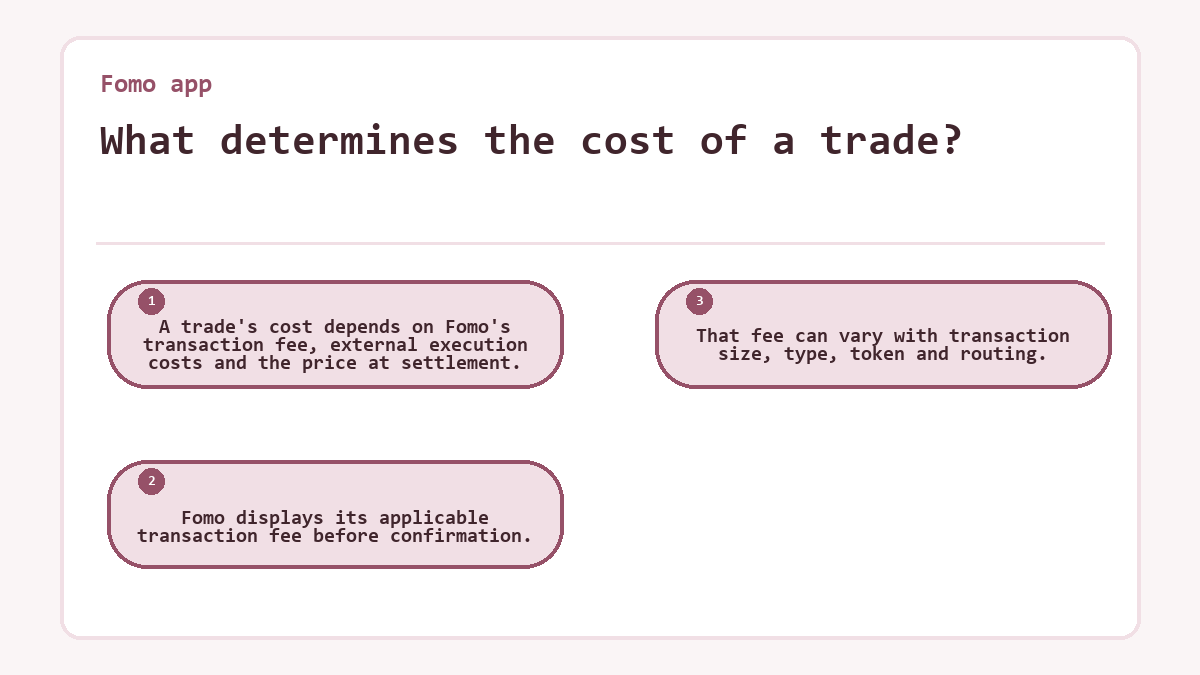
A trade's cost depends on Fomo's transaction fee, external execution costs and the price at settlement. Fomo displays its applicable transaction fee before confirmation. That fee can vary with transaction size, type, token and routing.
External costs can include liquidity pool charges, network fees and price differences between quotation and execution. Estimates do not necessarily include every cost. Gas sponsorship therefore does not establish that all trading is free. A sale also has its own transaction costs.
Derivative positions change the exposure you hold
Fomo provides eligible accounts with perpetual trading powered by Hyperliquid and Trade[XYZ]. Its perpetual features include isolated margin, long and short positions, take-profit orders and stop-loss orders. Position notional measures market exposure; position equity measures the position's value. Leverage magnifies gains and losses, funding payments can add costs and insufficient margin can trigger liquidation.
Perpetuals extend the social features to additional market categories, including crypto, equities, indices and commodities. The feed and portfolio can contain different instrument types. A shared account does not make their economic properties identical.
Perpetuals provide derivative exposure without ownership of the underlying asset. Robinhood stock tokens are also derivatives; they do not confer shareholder rights or redemption for the underlying shares. Their issuer is the counterparty to the derivative.
Wallet control depends on protecting account access
Fomo uses a non-custodial wallet model with exportable private keys. Authentication through email or Apple ID connects account access to wallet access. Protecting that identity therefore matters alongside protecting any keys that you export.
Fomo supports exporting wallet private keys for use with a compatible wallet. Compatibility matters because an external wallet must support the relevant key and account arrangement. Exporting a key does not itself transfer an asset.
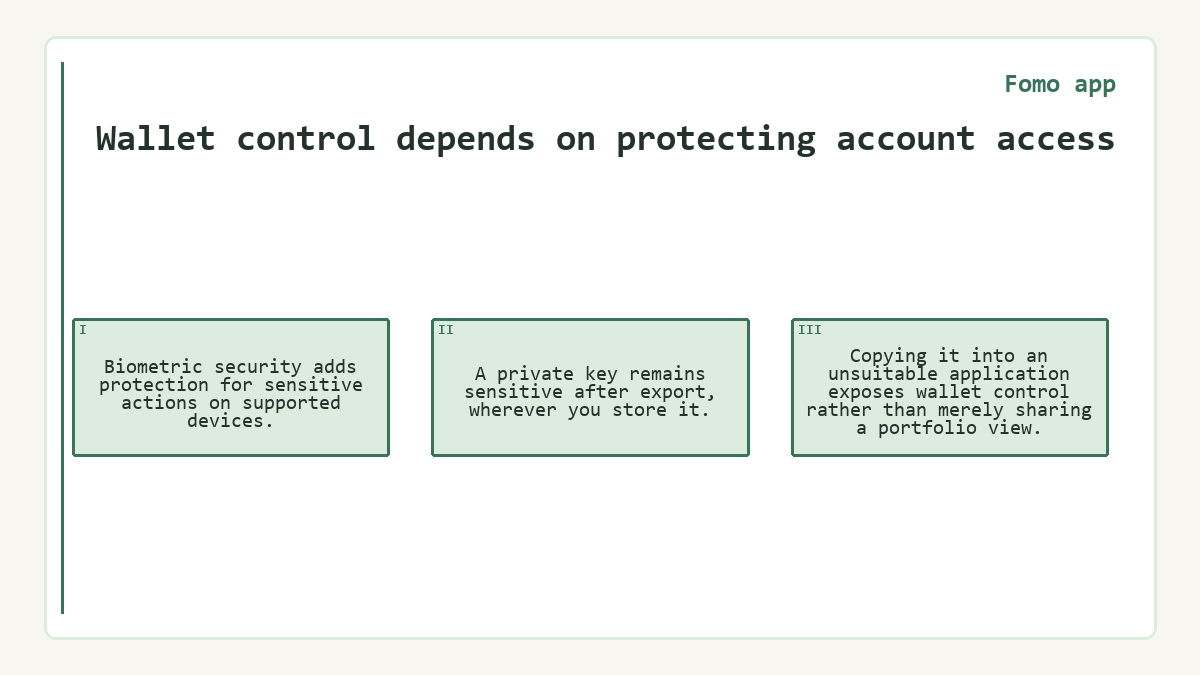
Biometric security adds protection for sensitive actions on supported devices. A private key remains sensitive after export, wherever you store it. Copying it into an unsuitable application exposes wallet control rather than merely sharing a portfolio view.
Transfers serve a different purpose from purchases
Fomo supports sending tokens to other users, including transfers with an attached note or image. This moves tokens to a recipient rather than exchanging them for another asset. A transfer message explains the payment; it does not change the asset that the recipient receives. Deposit notifications can display the amount in dollar terms, which is distinct from the token quantity itself.
Public trading activity and account privacy
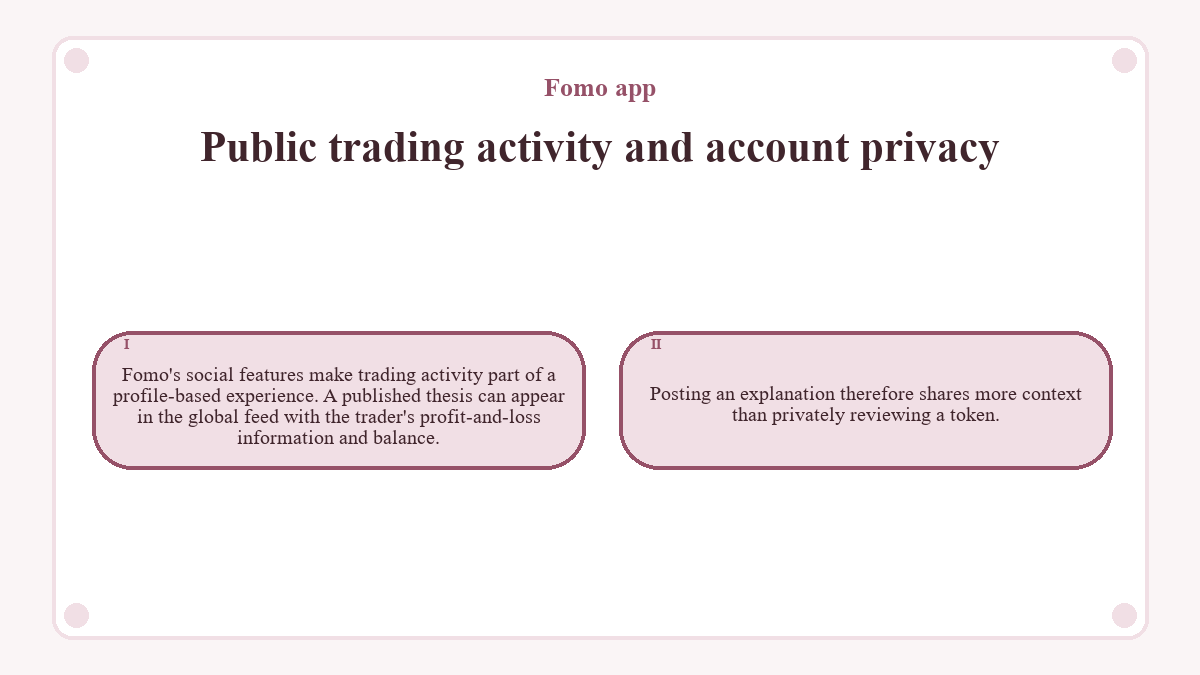
Fomo's social features make trading activity part of a profile-based experience. A published thesis can appear in the global feed with the trader's profit-and-loss information and balance. Posting an explanation therefore shares more context than privately reviewing a token.
Account privacy also extends beyond public posts. Fomo collects information supplied during registration and use, which can include contact details, linked social accounts and wallet information. It also collects device and usage data and uses service providers to operate its services.
A wallet address need not contain your name to become associated with an identity. Connecting financial activity with a recognizable profile changes what others can infer. Non-custodial asset control and privacy are separate properties.
Desktop continuity and the alternative of direct wallet access
Fomo web provides access to the same account used on mobile, including its balance, positions and following relationships. It suits a task that benefits from more screen space without creating another trading identity. Using the existing login preserves that continuity.
A general-purpose wallet offers a different approach when the task requires connecting directly to decentralized applications. Fomo concentrates on integrated trading and social discovery. The deciding difference is the operation you need: an available trade within Fomo, or direct interaction with an application that requires its own wallet connection. Key ownership alone does not establish application compatibility.
Still have questions?
-
Can Fomo help organize records for tax reporting?
- Fomo integrates with Awaken for tax reporting. The integration connects trading records with reporting tools accessible through the app. A generated report still requires the appropriate account history and transaction classification; the presence of a reporting feature does not establish the treatment of every transaction.
-
Do I need to write down a seed phrase when creating a Fomo account?
- Fomo's embedded wallet setup does not require the usual seed-phrase recording step. It uses account authentication and its key management system instead. Private key export remains available, and exporting a key creates a separate responsibility to protect that copy.
-
Are messages attached to Fomo token transfers moderated?
- Messages attached to token transfers undergo automated content moderation. Fomo supports adding a note and an image when sending tokens to another user. Moderation concerns the accompanying content; it does not establish that the recipient or purpose of a transfer is trustworthy.
-
Why can a trader's explanation appear outside a token's feed?
- Published trade theses can appear in Fomo's global feed as well as the relevant token context. This makes the explanation available beyond people already viewing that coin. A thesis is therefore a public social contribution rather than a private annotation attached only to the author's portfolio.
-
Is a separate exchange account required for Apple Pay funding?
- Fomo's integrated Apple Pay funding route does not require a separate exchange account. Its native fiat-to-crypto integration handles that funding path within the app. Access to the payment method remains separate from eligibility to trade a particular instrument.
-
Does Fomo show how a token's price changed after my first purchase?
- Fomo tracks token price movement relative to the first purchase and can provide related notifications. That price comparison differs from a full calculation of your trading result because subsequent purchases, sales and costs can change the economics of your holding.
Last updated ·